
- September 23, 2026
Marine Science Questions Answered: A Student's Guide to Degrees, Careers, Subjects & Research
Thinking about studying marine science? You probably have questions: What does a marine scientist actually do? Do you need to be good at math? Is marine science the same as marine biology? What degree do you need? Do marine scientists spend most of their time at sea?
What You'll Learn
ToggleThese are sensible questions, especially if you’re trying to decide what to study after high school.
Marine science is much broader than studying fish or working on a research boat. It brings together biology, chemistry, physics, geology, environmental science, mathematics, data analysis and technology to understand the ocean and the processes that shape marine environments.
And there isn’t just one type of marine science career. You might work with coral reefs, marine animals, ocean chemistry, climate data, coastal environments, underwater technology, fisheries, pollution or ocean conservation.
This guide answers the common questions students ask about marine science, from school subjects and university degrees to careers, fieldwork, laboratory research and ocean-exploration technology.
What Is Marine Science?
Marine science is the study of the ocean, seas and marine environments.
It looks at everything from microscopic organisms and marine animals to seawater chemistry, ocean currents, seafloor geology and the relationship between oceans and Earth’s climate.
One reason marine science is interesting is that no single subject can explain the ocean completely.
A marine scientist might need biology to understand an ecosystem, chemistry to study seawater, physics to understand waves and currents, and mathematics to analyze large amounts of ocean data.
That’s why marine science is often described as an interdisciplinary field.
Major areas of Marine Science include:
- Marine biology
- Oceanography
- Marine chemistry
- Physical oceanography
- Geological oceanography
- Marine ecology
- Fisheries science
- Coastal science
- Marine conservation
- Ocean and climate science
- Marine environmental science
- Marine technology
Is Marine Science the Same as Marine Biology?
Not exactly.
Marine biology focuses mainly on living organisms in marine environments. This can include fish, whales, sharks, plankton, corals, algae, microorganisms and other marine life.
Marine science is a much wider field.
For example:
Field | What it focuses on |
Marine Biology | Marine organisms and their biology |
Marine Ecology | Relationships between organisms and their environment |
Physical Oceanography | Waves, currents, temperature and ocean circulation |
Chemical Oceanography | Seawater chemistry and chemical processes |
Geological Oceanography | Seafloor, sediments and geological processes |
Fisheries Science | Fish populations, fisheries and sustainable management |
Marine Conservation | Protecting marine ecosystems and biodiversity |
Coastal Science | Coastal environments and their changes |
Ocean Technology | Instruments, sensors, underwater vehicles and data |
This distinction matters when choosing a university course. A student who loves marine animals may prefer marine biology, while someone interested in climate, ocean currents or underwater geology may find another branch of ocean science more suitable.
Why Study Marine Science?
For some students, the attraction is obvious: they love the ocean.
But studying marine science isn’t simply about spending your days on beaches or diving underwater.
It’s about understanding one of the world’s most complex environments and learning how scientific evidence can be used to solve real problems.
Marine scientists contribute to research involving:
- Ocean pollution
- Climate change
- Marine biodiversity
- Coral reef ecosystems
- Fisheries and food resources
- Coastal erosion
- Ocean acidification
- Habitat loss
- Marine conservation
- Sea-level change
- Sustainable use of marine resources
- Ocean observation and exploration
The field is also becoming increasingly connected with technology. Satellites, autonomous underwater vehicles, remote sensing, sensors, geographic information systems and computer models are now important parts of modern ocean research.
What Subjects Do You Study in Marine Science?
The exact subjects depend on the university and degree, but most marine science programs combine several scientific disciplines.
You may study subjects such as:
Biology
You learn how marine organisms live, reproduce, adapt and interact with their environment.
Topics can include:
- Marine organisms
- Cell biology
- Genetics
- Evolution
- Microbiology
- Marine biodiversity
- Animal physiology
Chemistry
Ocean chemistry helps scientists understand what’s happening in seawater and marine ecosystems.
You might study:
- General chemistry
- Organic chemistry
- Marine chemistry
- Biogeochemistry
- Nutrient cycles
- Ocean acidification
Physics
Physics becomes particularly important if you’re interested in oceanography.
It can help you understand:
- Waves
- Tides
- Ocean currents
- Temperature
- Pressure
- Fluid movement
- Ocean circulation
Mathematics and Statistics
Don’t skip mathematics just because you’re interested in marine animals.
Modern marine research generates huge amounts of data. Scientists use statistics and mathematical methods to identify patterns and make reliable conclusions.
Depending on the course, you may encounter:
- Algebra
- Calculus
- Statistics
- Data analysis
- Probability
- Mathematical modelling
You don’t necessarily need to be a mathematics expert before starting university, but being comfortable with numbers will definitely help.
Earth and Environmental Science
Marine science also connects with geology, geography and environmental science.
You may study:
- Seafloor geology
- Sediments
- Coastal processes
- Climate systems
- Environmental change
- Marine pollution
What Should You Study in High School for Marine Science?
If you’re still in school and considering marine science, focus on building a strong science foundation.
Depending on your education system, useful subjects can include:
- Biology
- Chemistry
- Physics
- Mathematics
- Environmental science
- Geography
- Computer science
You don’t have to decide your exact career at this stage.
A good approach is to keep your options open by developing both science knowledge and quantitative skills.
For example, biology can help if you later move toward marine ecology, while mathematics, physics and computer science can be valuable for oceanography and marine data science.
What Degree Do You Need for a Career in Marine Science?
There’s no single degree that everyone in marine science needs.
At undergraduate level, students may choose degrees such as:
- Bachelor of Marine Science
- Bachelor of Marine Biology
- Bachelor of Oceanography
- Bachelor of Environmental Science
- Bachelor of Biology
- Bachelor of Earth or Ocean Sciences
- Bachelor of Fisheries Science
- Bachelor of Coastal or Environmental Studies
The right choice depends heavily on what you want to do later.
For example, someone interested in marine organisms may choose marine biology, while someone interested in ocean circulation could choose physical oceanography.
If you’re not sure yet, a broader marine science or ocean science degree can allow you to explore different areas before specializing.
Do You Need a Master's or PhD in Marine Science?
Not always.
An undergraduate degree can lead to some entry-level roles, particularly in environmental work, field support, education, monitoring and technical positions.
However, advanced degrees become increasingly important for specialized research and academic careers.
A common pathway looks like this:
High School → Bachelor’s Degree → Master’s Degree → PhD → Research / University / Specialist Career
A master’s degree can help you specialize in areas such as marine ecology, oceanography, fisheries, conservation or marine environmental science.
A PhD is commonly required for people who want to lead independent academic research or pursue many university research and teaching positions.
The important thing is not to assume that you need a PhD simply because you like marine science. Your required education depends on the career you want.
What Does a Marine Scientist Actually Do?
This is one of the most important questions to ask before choosing the field.
The short answer is: it depends on the job.
A marine scientist might spend a day:
- Collecting seawater samples
- Studying marine organisms
- Analyzing samples in a laboratory
- Processing satellite data
- Writing research reports
- Using statistical software
- Mapping marine habitats
- Monitoring water quality
- Working with underwater instruments
- Conducting field surveys
- Developing computer models
- Presenting research findings
- Teaching students
And yes, sometimes that work happens at sea.
But a lot of marine science also happens in laboratories, offices, universities, research centers and computer labs.
Do Marine Scientists Spend Most of Their Time at Sea?
Usually, no.
The image of a scientist spending months on a research vessel is real for some careers, but it isn’t representative of every marine scientist.
Your work environment could include:
Laboratory:
Analyzing water, sediment, organisms or chemical samples.
Office or research center:
Working with datasets, writing reports, analyzing results or planning research.
Field:
Collecting samples, monitoring ecosystems or conducting surveys.
Research vessel:
Taking measurements and collecting samples offshore.
Underwater environment:
Some specialists may use scuba diving, remotely operated vehicles or autonomous underwater vehicles.
So before choosing a course, look beyond the exciting parts of the job. Ask yourself whether you’re also comfortable with laboratory work, data analysis, scientific writing and repetitive research tasks.
That’s a much more realistic picture of the profession.
What Skills Are Important for Marine Science?
You don’t need to arrive at university knowing everything. Many skills develop during your degree. Still, certain qualities can make marine science easier and more enjoyable.
Scientific thinking
You should be comfortable asking questions, testing ideas and changing your conclusions when the evidence says something different.
Observation
Field research often depends on careful observation and accurate recording.
Data skills
Marine science increasingly involves large datasets, statistics, mapping and computer-based analysis.
Communication
Scientists need to explain their findings clearly through reports, presentations, papers and sometimes public education.
Teamwork
Ocean research is rarely a one-person activity. Scientists often work with technicians, researchers, engineers, students, policymakers and other specialists.
Patience
Research doesn’t always produce exciting results. Sometimes experiments fail, field conditions change, or months of data analysis lead to a result that isn’t what you expected.
That is simply part of scientific work.
What Technology Is Used in Marine Science?
Modern marine research isn’t limited to microscopes and research boats.
Technology has changed how scientists study the ocean.
Some examples include:
Remote sensing
Satellites can provide information about ocean temperature, surface conditions, chlorophyll and other environmental characteristics.
Geographic Information Systems (GIS)
GIS helps scientists map and analyze marine and coastal environments.
Autonomous underwater vehicles
These vehicles can collect measurements in areas where continuous human operation isn’t practical.
Remotely operated vehicles
ROVs can be controlled from a vessel and used to explore underwater environments, often at depths that are difficult or dangerous for divers.
Ocean sensors
Sensors can measure variables such as:
- Temperature
- Salinity
- Pressure
- Dissolved oxygen
- Water movement
Computer modelling
Researchers use mathematical and computational models to study ocean processes and explore possible future conditions.
This is one reason computer science and data skills are becoming increasingly useful for marine science students.
Marine Science Career Options
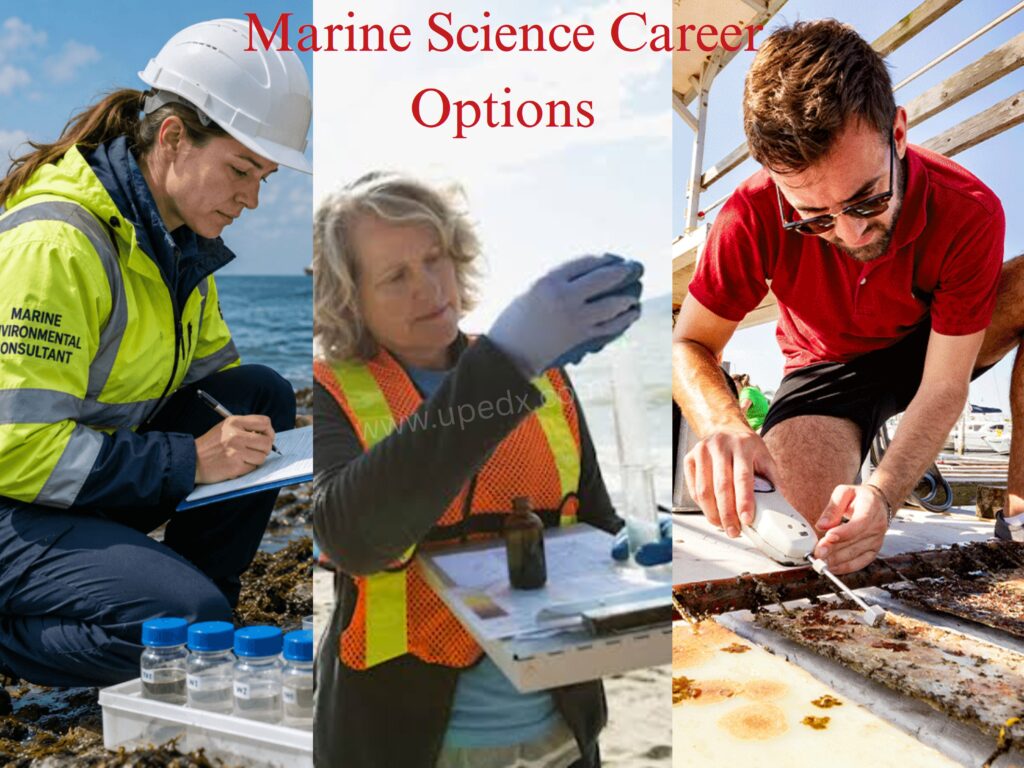
A marine science degree doesn’t automatically lead to one job title.
Your career can depend on your specialization, experience and additional qualifications.
Possible career areas include:
Marine Biologist
Studies marine organisms and their biology, behavior or ecology.
Oceanographer
Studies physical, chemical, biological or geological processes in the ocean.
Marine Ecologist
Studies relationships between marine organisms and their environments.
Fisheries Scientist
Researches fish populations, fisheries and sustainable resource management.
Marine Conservation Scientist
Works on protecting marine ecosystems, species and habitats.
Coastal Scientist
Studies coastal processes and environmental changes along shorelines.
Marine Environmental Consultant
May work on environmental assessments, monitoring and compliance-related projects.
Research Scientist
Conducts specialized scientific research, often in universities, government institutions or research organizations.
Marine Data Scientist
Uses statistics, programming and data analysis to work with ocean datasets.
Ocean Mapping Specialist
Works with mapping, geospatial data and marine surveying.
Marine Educator
Communicates marine science through schools, museums, aquariums, outreach programs or educational organizations.
Marine Policy Specialist
Connects scientific evidence with environmental management and policy processes.
These are examples rather than a complete list. Marine science can overlap with engineering, technology, environmental management and education.
Where Can Marine Science Graduates Work?
Marine science professionals can work across several sectors.
Potential employers include:
- Universities
- Research institutes
- Government agencies
- Environmental organizations
- Marine laboratories
- Aquariums and museums
- Fisheries organizations
- Environmental consulting firms
- Coastal management organizations
- Marine technology companies
- Conservation organizations
- Oceanographic research centers
The opportunities available to you will depend on your country, degree, specialization, work experience and professional qualifications.
What Can You Do Now If You're Still in School?
You don’t have to wait until university to explore marine science.
Try small, practical steps.
Read about ocean science.
Follow reliable science organizations, universities and research institutions.
Learn basic data skills.
Statistics, spreadsheets and eventually programming can be useful.
Strengthen science subjects.
Biology, chemistry, physics and mathematics all have applications in marine science.
Join science activities.
Science fairs, environmental projects and academic competitions can give you useful experience.
Look for volunteering or internships.
Aquariums, environmental organizations, universities and local conservation projects may provide opportunities depending on your location and age.
Ask working scientists questions.
One conversation with someone actually doing the job can sometimes tell you more than hours of reading career descriptions.
Final Thoughts
Marine science isn’t one narrow career path.
It’s a collection of scientific fields connected by one enormous subject: the marine environment.
If you enjoy biology, you might find yourself studying marine ecosystems. If you like physics and mathematics, oceanography could be a better fit. If you’re interested in technology, you could work with sensors, mapping, autonomous vehicles or marine data. And if conservation is what motivates you, marine ecology and environmental science may offer a natural direction.
The best place to start isn’t by asking, “What is the most exciting marine science job?”
Start with a more useful question:
“Which part of the ocean do I actually want to understand?”
Once you know that, choosing subjects, degrees, universities and career paths becomes much easier.